Showing posts with label Art. Show all posts

1 February 2015

Homesick for pilgrimage

I've often wondered whether it was possible to be truly homesick for a place that isn't really home. Last night, I got my answer: absolutely.

Part of our trip to the UK was a pilgrimage. We visited three cathedrals and several holy sites while we were over there. We started our pilgrimage on Christmas Day in NZ's northernmost Cathedral, Holy Trinity Auckland, which was pretty special as it was 200 years to the day since the preaching of the first Christian sermon in this land. We continued it with English cathedrals and holy places.

York Minister is jaw-droppingly beautiful. The feral GPS took us right into the centre of the old city within the walls - to the point that we nearly ran into the pedestrian-only zone through the Shambles (oops); but as a way to see the Cathedral, driving up Museum Street to the York Information Centre pretty much can't be beaten. The Minster just loomed up out of the frost, with the morning light behind it, shimmering on the golden stone, and the Heart of Yorkshire tracery in the Great Window catching the sun. Inside, it's even better. I literally had to scrape my jaw off the floor when we walked into the nave and looked up. I have never seen anything so lovely as those pillars of stone reaching for the sky, and the gilded bosses and ribbed ceiling. We did one of the guided tours, which was very interesting but quite long. I loved the crypt, with the tomb of St William of York (very simple, a single block of stone with a candle burning on it), and the ancient paintings. We went back later on that day for evensong in the quire. Candles, choir (a visiting choir - the Minster's one was on holiday but they were very good), and that thunderously gorgeous organ. Worship was a whole body experience: the feel of the organ, the smell of wax and candles, the music, the silence. Prayers offered for the prayer intentions left in the Minster. Very down to earth and grounded in reality, even in the midst of the glorious music.

Sheffield Cathedral on New Year's Day: very quiet and peaceful. Reminded me a lot of the feel of Wellington Cathedral of St Paul although it's much much older and looks nothing like Wellington's "big pink sarcophagus"! It's not one of the "famous" ones but it was very lovely. We liked the fact you could see the Norman, Gothic, and later additions very clearly, and it had a gorgeous chapel to the Holy Spirit that I particularly liked. It also had the coolest of all the nativities we saw: made of Sheffield steel, about 1.5m high, and somehow the makers had made that steel very winsome and gentle.

Grace Dieu Priory was not on our original itinerary: my sister-in-law suggested it as it was just up the road from their place near Loughborough. We got there by a very cold walk through English woods in the snow, which was interesting in itself: I was quite surprised by the lack of undergrowth, bushes etc - just trees, and they seemed fairly widely spaced. I don't think it was deliberately planted but it had a "managed" feel. The priory itself is a ruin, but it was beautiful. The stonework was all iced with thick snow, and the walls rose out of snowy fields. The late afternoon light was very kind to the stonework, and the whole place had a kind of breathless hush, almost as though it was waiting for something. It had the feel of a "thin place": it knew it had once been holy ground, and the sense of consecration was still there. It was very cold! Having the deep snow helped the sense of hush too. The pond beneath the priory was frozen solid (small daughter threw a good-sized rock just to make sure and it skidded for several metres!).

Most people wouldn't consider Stonehenge a holy place, but I do. Most modern scholarship seems to think that it, and the landscape around it, was holy to the prehistoric peoples, and that Stonehenge was a place of worship. I certainly sensed that when I was there: It is so old, so unbelievably old, and it was in use for over 1000 years for whatever the ancients did there. It has left a mark on both the physical landscape and the landscape of Spirit. I spent some time trying to listen to the place (rather difficult when it's swarming with tourists!). I got the sense that Stonehenge isn't quite sure what it is anymore, but that when it's quiet, after dark or at the turnings of the year, it would go back in time a long long way. It would be a place of awe, and to me, that's what worship is: finding the awe, the marks of our recognition of the numinous, in places, times, music, art, and people - the places where God has touched us and we have touched God.

I suspect the National Gallery isn't on a list of holy places for many people either, but there were so many wonderful works of art, many of them altarpieces or great artist's explorations of religious themes that it was definitely part of our pilgrimage. So many artists, so many places to go in the world through the art, so many themes of love and beauty, power and betrayal, peace and war and everything in between. Highlights too numerous to mention, but seeing Leonardo da Vinci and Raphael in the same building was pretty amazing, not to mention Holbein, Constable, Turner, Degas, and a whole lot more.

Westminster Abbey was a different kind of holy: the holiness of the ordinary, the holiness that we find through living our lives and contributing to society. It also turned into a very personal moment, when I found a shrine to one of my ancestors, and the tomb of another (a Dean of Westminster). Did not expect that at all! Partly because of the number of people there, it was hard to get a sense of the Abbey as a working church, except at the prayers on the hour (when one of the Canons requested everyone to be still for a few moments while they offered prayer). We didn't go to the prayers at St Edward the Confessor's tomb, although I did spend a few moments reflecting there. I found it hard to get a sense of the architecture too, because there were so many monuments and grave markers - I found some old friends, like CV Stanford, Howells, Dryden, Keats, Shakespeare, and rather endearingly, CS Lewis (no Tolkien though). Also Queens Elizabeth and Mary (in a shared grave, rather beautifully). Henry V, and Henry IV.

The jewel in the crown, and the finale of our pilgrimage, was Canterbury Cathedral itself. We were staying in the beautiful, peaceful Cathedral Lodge within the precincts of the Cathedral - it was tasteful, comfortable, and luxuriously beautiful in a very understated way. What was amazing was how the noise of the city just disappeared when you went through the walls into the precinct. The old city walls are stone and incredibly thick: the grounds are almost silent. The Cathedral opened on us like a revelation as we came through the gates from Quenensgate. After a very late lunch we went in. The sense of prayer and Presence hits you the moment you walk through the doors - there is a holy hush in the building not of any person's making. It just is. We were blessed enough to arrive about 15mins after Saturday evensong had begun (we got there about 3.30pm), so there was a tide of glorious music and resonant organ everywhere. We went to explore the crypt, beginning with praying at the Martyrdom of St Thomas Becket, and then visiting the various chapels in the crypt - all with evensong washing over us, even through the thick stone of the ancient Norman crypt. There are some very ancient wall paintings in one of the chapels that gave us a tiny sense of the riot of colour the Cathedral would have once been, but it was the atmosphere of the place that kept stilling us. The place where St Thomas' body lay, in the Chapel of St Mary of the Undercroft; the place where his tomb was before they built the shrine (that Henry VIII pulled down). The single candle that burns where the shrine once was. And of course the tomb of Edward the Black Prince. Over 1500 years of continuous prayer has marked this place. The very stones pray and praise.

The next day we went to choral eucharist there, in the quire, with the light blue and gold and red through the stained glass. Incense. Singing. Organ. Psalms sung to chant like I've never heard them before. Processions of readers, the Gospels, holy gifts. Receiving communion at the High Altar of Canterbury Cathedral. The taste of port on my lips, the holy body and blood. More singing, and hearing the purity of those boys' voices soaring in the Anthem.... Prayers, very down to earth, for ordinary blessings, ordinary pains, ordinary joys. Being encouraged to pray the Lord's Prayer in our own language - I started in Maori but got lost amongst all the English! Blessing the water for the holy water font. Finishing with Psalm 150 for the Recessional, soaking the stones in praise and prayer yet again.

And at the end of the service, gathering with Canon Nick in the Chapel of Our Lady of the Undercroft for our pilgrim blessing, giving thanks for the journey we had made and the one we were to make home. Holding Canterbury specially in my heart, trying not to cry as we left. None of us wanted to leave. Trying to carry Canterbury with me, St Thomas, the Martyrdom, the crypt, and the praise soaked into the stones.

Can I be homesick for a place I don't belong to? Yes, I can. I'm homesick for Canterbury. I am homesick for the Presence of that place, for the stillness, the silence, the beauty of the worship, the smell of incense, the thunder of the organ and boys' voices soaring in praise. Beautiful stone and light and glass. The warmth and kindness of the welcome we received from everyone. The place of martyrdom, destination of millions of pilgrims like us through the centuries. The place marked by God's presence and our recognition of God's presence.

Now I need to find those places here, find a way to bring it home to smalltown New Zealand, land of sheep, green fields and bright sunshine. It's going to be a long job.


27 February 2014

Of books and bikes

Had another idea in the book space the other day. Small daughter and I had a bookbinding afternoon and I taught her what I had learnt about making a text block, and then we covered them with paint swatches. Yep. Paint swatches - those little squares of paint colour printed on cards that people use when they're redecorating (used plenty of them for that purpose myself!). Re-purposed. They looked pretty neat actually.

Haven't made anything since this session with daughter, but am plotting a sushi-mat binding. I was digging around in our drawers looking for some kitchen implement the other day when I unearthed our sushi mats from hubby's several attempts at home-made sushi (usually very tasty but not exactly structural!) and I was struck by the idea that it should be possible to bind signatures directly onto the mat. If I cut the pages tall and thin it could make a cool book. Planning to try this sometime shortly. Definitely need to have another crack at case binding too, now I've found some hard, thick non-corrugated cardboard (this is surprisingly hard to find) and a slightly less stinky glue than PVA!

Am quite busy with work, and have recently joined the Rotorua Chamber of Commerce for networking opportunities. It was quite weird at the meeting on Tuesday night - I found myself thinking that I used to think it was only boring old farts that were members of things like the Chamber of Commerce, and here I am part of one! I hope that doesn't make me a boring old fart....

I am also spending a lot of time on the exercycle, and am considering getting myself a x-trail bike. Hubby and I went to have a look at bikes the other day and I found something I really liked - which is mildly scary because I haven't been on a proper bike in about 20 years! But most of Rotorua is really flat through the city, with wide streets, and surrounding us are some of NZ's best mountainbike trails. It seems silly not to take advantage of what our city offers! I could easily get to and from town on a bike based on the distances I'm getting on the exercycle each day, and I always loved going for a bikeride when I was younger - the freedom of it all, especially when I wasn't using it as a means of conveyance from A to B. Watch this space!

27 January 2014

In pursuit of books

It is no secret that I am a bookworm. I have been called that since I was really tiny and it offends me not at all! It is perfectly possible for me to simply not hear someone when they talk to me when I am truly engrossed in a good book - although the opportunity for that kind of deep concentration is less now that there is a small daughter around!

Recently though, I have been investigating another side of books - the making side. It all started just after New Year when hubby and daughter were away for 10 days in Wellington, while I was working in Rotorua. I was wishing that I had a hobby that I liked to pursue, and not feeling like picking up my current tapestry canvas (which has been languishing on the frame for some years now!). I was reading The Book of Air and Shadows by Michael Gruber (great read, by the way) which begins in an antique book dealer and restoration shop, and I began to wonder whether it was possible to learn to bind books at home without a great deal of equipment or cost.

I came, I googled, and I made books. There is a heap of information out there, plus buckets of very cool photos of art-bound books that I am totally in awe of. My favourite website so far is "Adventures in Bookbinding" and there are some great Youtube tutorials. The best I've found are by a lady calling herself Sea Lemon, which are video/narrated tutorials of how to do different parts of the bookbinding process, including making a stitched text block (the pages bit), case binding (hard cover with glued fabric), and lots of kinds of fancy binding including moleskine and Japanese stab binding that I haven't tried yet. My first attempt at case binding didn't come out quite as well as I'd like but it looks okay, and my second book attempt (which was basically a sewn text block with sewn-on cardboard cover) looks really cool. I want to try case binding again because I think it will need some practice to make it work properly.

I got an idea today that the fancy papers that scrapbookers use might work quite well in books - so far I've just used plain 80gsm white A4 printer paper for my text blocks because that was pretty much all I could immediately lay my hands on at home (unless I raid small daughter's craft papers which I am strenuously resisting doing!). I got a small pack of scrapbooking paper, cut each sheet in half to make it go further, and made a concertina book, gluing each of the folded pages to make a concertina. It looks great: I just have to figure out what I'm going to cover it with.

I might use the rest of the scrapbook pages interleaved with other papers and stitch another text block. I've also got an idea lurking around about a slightly unusual cover, inspired by the photo on this blog post. I also want to fossick around in hubby's art gear - I seem to remember that we've got some art drawing paper that would probably do really well. I have an errand to run for work tomorrow and I think I'll try to time it just before lunchtime, as there is an art supplies place in Rotorua that I haven't been in (I was sighing for Gordon Harris Art Supplies - I remember ogling all the gorgeous paper stock they had there when hubby was getting his last set of photography matte board!). I also want to find an awl for punching pages for sewing "signatures" (the groups of pages) - I have been doing this with a sharp needle and seem to be going through rather a lot of sticking plaster....

I wish there were book binding classes in Rotorua. Such a pain that I discover this after we leave Wellington, where there are a number of specialist binderies and lots of classes. Anyway, I seem to have found me a hobby. And I like it!

30 August 2013

Wagner and das land

I have just been reading my brother's blog about his recent foray into Wagner's Ring Cycle, with the BBC Proms. Sounds like it was completely amazing, and I am so jealous that he got to hear Bryn Terfel live. He did the complete Ring, which is pretty cool. I have to admit that I have only heard parts of the cycle, but what I have heard I like. Maybe I'll have to look up a good recording and have a listen to more of it.

However, on the other side of the globe, things have been a little interesting. Last night we were  rudely awoken by an earthquake around 1am, followed by another 6 quakes until about 2.30am.... They were fairly small but the epicentres were just 1km from our house, and only 5km deep. By the time we'd had the 5th one small daughter was so unnerved she wanted to stay in our bed (which I can't blame her for!). They were extremely noisy - in fact, I was woken by the first one and was trying to figure out where the truck was driving when the shaking started! So we ended up all of us sleeping in our queen bed, and the cat, not to be outdone, came to join us too... We all did get some sleep but it wasn't the most restful night I've ever had. Fortunately I was working from Rotorua this morning so didn't have to deal with the drive over to site.

This week has been a very busy one with a major audit on Tuesday and Wednesday. I've been preparing for this for months now, and particularly over the last few weeks it's been taking up a lot of my time. In the end it went pretty well, which pleased me (and my boss). I was concerned that my lack of spoons from the weekend/Monday may have made it difficult when it came to the site walkthrough on Wednesday, but I did okay in the end. I must admit that I came home on Tuesday and didn't want to talk to anyone (other than hubby and small daughter), after spending all day answering questions from the auditors! Long meetings are stressful when you're an introvert and an audit makes it worse. I am very grateful it's the weekend!

It's also been an interesting week in terms of the year too. Two feasts and a memorial in a row, with St Monica, St Augustine, and the Beheading of John the Baptist back to back. I don't know a lot about Monica, except she was Augustine's mum, but Augustine I know more of. The readings for vigils were from the Confessions and they were really gorgeous - from his investigations and meditations on the One Beauty. I have to confess I've never finished the Confessions - I did read quite a bit of them in patches when I was studying, and an awful lot of his theology, but I never did the Confessions from start to finish, although I did try. This makes me wonder whether it wasn't the right time for them then but it may be time for another go? And John the Baptist: I know it's the wrong image but I always think of Allori's Judith with the head of Holofernes when I think of this event. But also as forerunner, beginning, cousin, friend, torch, Elijah Mk 2... It was a bit of a relief to return to ordinary Ordinary Time today.

20 May 2011

A History of Christianity

There's been a bit of a blog silence from moi for the last couple of weeks. No particular reason: just nothing significant to write about! After Graduation last week, I plunged into a huge amount of training and work - I think it's been two days in the office in the last fortnight. I've also been training a new colleague, who's been following me around watching me deliver training and getting a feeling for our style of delivery, which I found mildly intimidating at first! However, it's been quite good so far and he's going to co-deliver with me next week, so that could be interesting (I've never co-delivered training so am not sure how it works!).

However, the prompt for blogging has come from my brother. He has sent me the absolutely fabulous A History of Christianity BBC series by Diarmaid MacCulloch, the Professor of History of the Church at St Cross College, Oxford. This sumptuous series is beautifully filmed on location in some of the most important sites throughout Christian history, including China, Baghdad, Jerusalem, Rome, Spain, Mexico, all over Europe ... in fact, I am completely and totally green with envy over where he went to! It is engagingly presented by Prof MacCulloch, who is one of the world's foremost experts on the history of Christianity, and he definitely knows how to tell a good story and keep people interested. I spent years studying church history when I did my BMin but I've learnt things from his series that I never knew, including about the "Church of the East" centred in Baghdad and their mission to China and Japan in the 8th century!

The series is based on his magisterial A History of Christianity: the first three thousand years, which was a bestseller (and not just to church history nuts!) in 2009 on release - the Archbishop of Canterbury has called it the "definitive work" in the field - which is something coming from a scholar like Rowan Williams! A good story well told... to the point that I have just ordered the book from Amazon. Can't wait - but think it might not be one for lugging to work for lunchtime reading as it's over 1200 pages....

Some personal highlights from the first four episodes of the programme: the rediscovery of a Christian church in China dating from the 8th century (now being used as a Buddhist monastery); his extremely clear and lucid discussion of the causes of the Great Schism in 1054 between Orthodox and Roman churches; the Church of the East; nearly a whole episode devoted to Orthodoxy, looking at it in Eastern Europe, Russia, and other places. I am waiting to hear his treatment of monasticism - I've seen four of the six episodes (the other two are on their way, I'm told!) and so far he hasn't dealt with monasticism at all and you can hardly trace the history of Christianity without looking at the influence of monks!

This is fascinating, beautiful, interesting history. Even if you're not into God, church, or anything else "religious" it's worth watching because he investigates the links between Christian history and the political landscape beautifully, and the locations are just stunning. Thank God for the BBC, is all I can say right now!

30 January 2011

A moment

Just happened to look up from my computer for some reason to notice that the light coming through the front door had suddenly changed. We just had the most amazing golden sunset - literally streaks and splashes of brilliant shimmering gold across the sky, and all the houses and hills washed with the most incredible light. It looked almost stripy, but was outlining every ridge on every cloud. I regretted the absence of the camera for about 5 seconds, then decided I would far rather just stand there and enjoy it rather than trying to "capture" it. It only lasted about 5 minutes but it was amazingly beautiful - in fact, beautiful isn't really a big enough word.

It's moments like these that I just stand stunned by God's artistry. The science of how and why it happens are unimportant - I understand them, but I would rather appreciate the beauty of what I have just seen, and give thanks where it is due.

21 November 2010

European Masters

Yesterday was an interesting day. We went to the European Masters exhibition at Te Papa: 96 paintings from the Stadel Museum, mostly German artists of the 19th and 20th centuries, but some earlier stuff too. Favourites: the little Monet, Houses on the Banks of the River Zahn, the Renoirs (including After the Luncheon, wow this was lovely)

Renoir: After the Luncheon

The Degas (Orchestra Musicians):

Degas: Orchestra Musicians

And a most stunning Dahl, The Eruption of Mt Vesuvius in December 1820.


Dahl: Eruption of Mt Vesuvius December 1820

The one that completely captivated me was Carl Lessing Die tausendjährige Eiche (The thousand-year-old oak) 1837 - unfortunately I can't find a picture of this.

And I saw my first Picasso.


I liked the exhibition and some of the paintings were stunning. However, I did learn something about me, or rather had it confirmed. I like landscapes, I liked some of the neoclassical work, but I didn't really like the modernists. I have to admit that I was not impressed by the Picasso. I couldn't get what it was trying to say.

I liked the representative things more, and the Lessing was stunning. I kept going back to it. The thing was huge and the detail was incredible. It had this little twisty river heading into a gap between rocks and I really want to go and exlore that space. If ever I've wanted to do an Alice Through the Lookinglass with a painting, it was the Lessing - and Constable's Salisbury Cathedral from the Bishop's Grounds, of course.

22 October 2010

Nelson trip pt II

Golden Bay, on the other side of the Takaka Hill, looked quite different from the area around Nelson – much more lushly green, less wineries, more sheep and cattle. I know there’s a dairy factory there somewhere so that explains all the cows – or maybe the cows explain the dairy factory! Lots of what I think of as very “English” scenery – single trees here and there just coming into leaf, little rivers, grass – although the wonderful, steep mountains on either side belied the English look! And they really are steep: great swoops of rock with a tiny bit of grass and scrub, but most of it is so steep (read nearly vertical) that there isn’t purchase for plants. Also I think the limestone/marble is probably too alkaline for most plants. I’d imagine it gets a little cold through there in winter: there was still snow on the tops, especially on Hoary Head.

We had lunch in tiny Collingwood, and then went out to Farewell Spit and walked the beach – not all of it (too far for 4 year old legs!) but a good two hours or so wandering along. Lots of jellyfish washing up on the beach fascinated daughter: she was scared at first when we told her not to touch them (they looked quite colourful and we didn’t want her trying to pick one up), but then I explained how they propelled themselves but still got washed onto the beach. She decided that the jellyfish were having “a bad day” because they were drying out on the beach!

On the way back to Nelson we stopped off at Waikoropupu Springs, which I’ve already blogged about here. I loved this place, but was slightly uneasy about it too. It was unbelievably beautiful – you have to see it to really comprehend how lovely it is – but it is a place of power too and I felt it. I think it would have been easier had we been allowed to touch the water, as it would have given me a physical connection with the place.

Friday I was working, and hubby and small daughter went out to Split Apple Rock – the tide was right out so they could get into the caves near there that are underwater at high tide. It looked really lovely. They also did a bit of driving around the general area, heading down towards the Nelson Lakes. We went to Chokdee, my favourite Thai place in Nelson, for dinner.... mmm, Thai!

Saturday, our last full day, was spent at the World of WearableArt museum (I’ve been before, but the others haven’t – love it) and Founders Park, a craft area that’s set up in a pioneer village situation (also mixed with historical displays). There is an extensive collection of ships in bottles (and bouys, and lightbulbs, and vases!) that daughter found really interesting. WOW was amazing as always: they had cycled through a different collection of costumes from the ones I’d seen before and seeing them up close and personal like that was incredible. Next year I really want to go to the show!

We then split forces: hubby wanted to go to the Nelson Museum and daughter and I headed off for a swim, and a walk on the beach afterwards. We came home on Sunday – it was rainy and miserable on the ferry, but a very smooth sailing on the whole, and we enjoyed breaking our cat out of kitty prison and bringing him home again – he has been very affectionate since so he obviously appreciated being rescued!

20 October 2010

Nelson trip part 1

Well, I’ve been promising a bit of a writeup of our recent holiday in Nelson. I had some work down there last week and this time I took the family with me. We stayed at the Kingsland Court Motel, where I usually stay when I’m in Nelson – it’s within spitting distance of Tahunanui Beach and quite near the airport and where I usually work.

We took our car over on the interisland ferry last Tuesday – it was a gorgeous sailing, if a little cold and windy at times and there was heaps to look at as we went out through the Heads out of Wellington. Hubby thought it was quite rough but he doesn’t like boats all that much (much to my disappointment!). Small daughter found the boat really interesting, especially as we got into Tory Channel and could see the South Island sliding by. Hubby got some great photos of the light effects and of the channel – hopefully I’ll be able to post some here.

We enjoyed the drive through to Nelson – one that neither of us had done before – although small daughter didn’t enjoy the “bendy bit” at the end and we had one abrupt stop... ‘nuff said. It was very beautiful threading down around the bottom of the Sounds, and coming into Nelson from the north was amazing. Gorgeous light on the mountains across the estuary, picking up the snow that had fallen the day before (snow in October! It’s meant to be spring!).

We checked into our motel and then I took them all into Nelson for a walk. Small daughter wanted to visit the Cathedral, and loved the beautiful stonework and stained glass. The late afternoon sun was streaming through the windows, splashing the columns with shimmering light. Daughter and I walked the labyrinth (she did it four or five times, she liked it so much!) while hubby took some photos and explored the chapels and windows. We finished with dinner at Smugglers, one of my favourite eateries in Nelson.

Our first full day was Wednesday: Höglund Art Glass and Eyebright Gallery in the morning, and Seifried Estate winery and a walk on the beach at Rabbit Island in the afternoon. Höglund was amazing. The colours, the depth of the glass, was mind-blowing – it’s all hand-made and incredibly beautiful. They have a great display section about the various chemicals that are used to get the colours, and a video to show the process – unfortunately they weren’t blowing so we couldn’t actually see it but it was the next best thing. Small daughter found the process really interesting, and liked watching how they blow the penguins, one of their specialities. Eyebright wasn’t as good as I’d expected – in fact, it was the only place that I wouldn’t want to return to.

Wine-tasting at Seifried was good: some interesting tastes, especially among the aromatics that they are known for. We tasted the late harvest that won the world aromatics medal (mmm), and got one of their Sweet Agnes’ dessert wines – we wanted something that we couldn’t just get in the shops here. We finished with a wander along the huge beach at Rabbit Island – miles of flat golden sand, very sheltered, and the water was warm enough for splashing in (although not swimming quite yet). Daughter had a wonderful time chasing and being chased by the waves – so cute!

Thursday we ventured a bit further afield: quite a lot, in fact. We went over the famous Takaka Hill (composed, so I am told, of marble and vomit – it has quite a reputation!), stopping several times for walks and fresh air, and visiting the various lookouts. They call it a hill but it’s pretty huge (721m) and it’s karst country: limestone, sinkholes, marble, and NZ’s biggest cave, Harwood’s Hole. I declined to go visit – it’s a 183m drop straight down and I wasn’t game! The view from the top was spectacular, over the estuary and the fields. Wonderful.

More to come!

16 September 2010

Little happenings

These last few days have been quite fun. I've taken a week's leave - some of it for study, some for a rest! - and have been spending quite a bit of time with the family.

Monday, however, was a study day. I spent a fair proportion of it in at Archives New Zealand, looking up papers for my report on the Wahine disaster. It was quite a moving experience, in a lot of ways. I was handling papers that were part of the evidence to the original Court of Inquiry in 1968, including the original Navy divers' photographs of the damage to the ferry. I found a heap of useful stuff, the most important of which was an affidavit for the initial investigation from the Harbourmaster who was not able to be present at the Court of Inquiry, as he had been in a serious accident. This evidence had not been referenced in any of my other sources and added quite a bit to the picture I'm building up of what happened.

I've spent quite a bit of time at the gym this week too, and have been really enjoying it. Also seeing some results which is rather nice so quickly! Just little results for now, but I've dropped some weight already and am feeling a lot better in myself for having some good exercise going on. I decided not to go today - after three days in a row in the first week I felt my body needed a short break (and we had a huge family ramble today anyway), but will be back tomorrow. We're away this weekend so not sure how that will work out, but I'd like to have even a quick cardio at some point, given I'll be spending most of it sitting down at Synod!

Today we took small daughter to Te Papa (again). She wanted to spend a lot of time in the "Awesome Forces" exhibit today and was asking lots of questions about how earthquakes happen and why - the displays have recently been updated in this area and we were able to explain to her the kind of earthquake Canterbury's had and helped her understand why it happened.

We then spent a lot of time in Toi Te Papa/Art of the Nation, which is a new exhibition of some of the art collection. I was stunned to find one of my all-time favourite NZ paintings in the exhibition, which I'd only ever seen in a photograph (a very small one!) - and there it was live and in full, glorious colour...


It's the Pink Terrace, by Charles Blomfield - unfortunately this is a fairly grainy copy! These beautiful natural features (the Pink and White Terraces, on the edges of Lake Rotomahana in Rotorua) were destroyed in the Tarawera Eruption of 10 June 1886 - they completely disappeared. Each later of these sinter terraces was taller than a person, with many layers and pools of geothermal water. People came from all over the world to bathe in them. The Pink Terrace (Otukapuarangi, "fountain of the clouded sky" in Maori) was slightly smaller (although "small" in this context is a bit of a misnomer), and was a paler pink at the bottom and became a deeper colour further up to the top. The White Terrace (Te Tarata, "the tattoed rock" in Maori) was a shimmery white from bottom to top, with different-coloured pools of differing temperatures for bathing. It is such a tragedy that they're not there any more!

Anyway, back to Te Papa. Small daughter was fascinated by this painting, and by a number of others in the collection. She didn't like the Woollastons (fair enough, I didn't either!) but loved some of the portraits.

And now I'm turning my attention towards our Diocesan Synod this weekend. Synod is the major decision-making body in an Anglican Church, a mix of lay and ordained people chaired by the Bishop. Each parish has lay representatives and all ordained clergy who are currently with Licenses (ie working in parish ministry) have to go. I went last year as a youth representative, but this year I was elected as the parish representative so I have voting rights. It's also a great chance to meet and catch up with some of my friends in other parishes!

22 July 2010

Out of print but not out of stock

I'm a happy elephant. I have finally found an online bookshop that doesn't charge half the earth and the moon combined for postage to New Zealand. Thriftbooks seems to carry a range almost as good as Amazon.com but charges about half the price to ship over here. They also have a great arrangement whereby if you order more than one book from the same warehouse or city, they charge you less for the book - which works out as a shipping discount (the actual price of shipping doesn't change but the overall price is cheaper). Amazon doesn't do this, which annoys me.

I have been searching for a few out of print books that were never released in New Zealand about a group of ballet students. The first four books in the series were released here, but the other 8 were not (how annoying is that!) - which of course means that no second hand bookshop here is likely to have them. Even my beloved Arty Bees doesn't have them, and they have a huge range of second hand and new books and carry lines that very few other bookshops do. However, I found the rest at Thriftbooks and the cost of books and postage combined is less than half what Amazon was going to charge me, and even with the exchange rate it's still a good buy.

Me happy now. Me will be even happier when the things finally arrive and I can find out what happened to all the characters! I first read the earlier books as a teenager and have picked them up over time as I've spotted them in second hand shops, and they are ones I often return to when I want something simple and uncomplicated to read that feeds my love of ballet!

Speaking of ballet, the family and I went to Te Papa on Sunday after church to watch the Royal New Zealand Ballet's open day "A Day in the Life". Several dancers from the company did a class in the Te Papa marae, and then danced pas de deux from Romeo and Juliet and Carmen (the modern-dress production they did last year). Awesome - and so beautiful. It was slightly frustrating that they maxed out the sound system and it kept stopping, but the expression and communication of the feelings of the characters came through very clearly. One of the more interesting things was the dancer playing Carmen was wearing handcuffs, and they made a great play of her dance with the handcuffs on. Brilliant.

2 July 2010

On the road again

I am home from our company's professional development days in Auckland. We had a presentation from an adult learning company who is helping us revamp our training courses and training approach yesterday, which was good, followed by dinner at the Viaduct. Dinner didn't start until about 8pm, which was pretty rough on my very primitive digestive system! We usually eat around 6pm at home because of our small person, who goes to bed about 7.30. It didn't help that I'd been up since 5am because of having to connect with the 7am flight to Auckland. A colleague and I abandoned the dinner straight after the main course at about 9.30ish and went back to the hotel to get some peace and quiet - apparently a number of the others did likewise but there were quite a few getting rather hilarious until very late.

This morning was excellent: our MD was talking about contractor management and safety by design in procurement, which is a big project he and another director have been working on, and an area of major interest of mine. He was superb (as usual) and it generated a lot of good, constructive discussion - unlike this afternoon, which was unstructured and got a bit more messy. By afternoon tea, I was losing the will to live, or at least to stay in the discussion....

One highlight for me was our location - we were at the Skycity Convention Centre right in the heart of Auckland CBD, which is right around the corner from the beautiful St Matthew's-in-the-City Anglican Church on Wellesley St. St Matthew's is a church I've been wanting to get inside for years - it's a gorgeous neo-Gothic pile in the heart of Auckland and I've wanted to explore it. Today I took my chance. We only had half an hour for lunch so I grabbed a very quick bite and headed over the road to look around. I was struck by its peace: it is on the corner of two of Auckland's busiest streets (Wellesley and Hobson) but it's nearly completely silent inside, with only the sound of very soft organ music playing.

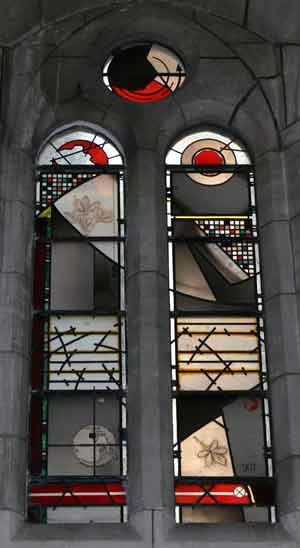
It is a soaring, beautiful building with heaps of very nice stained glass from varying periods, including two more recent compositions I recognise as being done by the same glass artist who did a number of the windows at Wellington Cathedral. The Erebus window was beautiful and very poignant, all in shades of grey and silver and blood-red. I'd never seen anything like it in glass art. I found it particularly moving because I have met a number of people who worked on victim recovery after the Erebus disaster, and the report on the Perpignan Air NZ crash (which happened on the anniversary of Erebus) was released last week.

The font was also very nice: luminous semi-transparent marble lightly veined with gold, with a design of carved leaves wrapping around the top. I also noticed they had put a large glass bowl inside the marble font, which will make filling it (and more importantly, emptying it!) much easier for the sacristans! I also loved the soaring pillars of creamy stone (not sure exactly what kind of stone it was) and the lovely wooden roof - hard to tell, but looked like a hammerbeam roof. Lighting was subtle, picking up the pillars, windows, and the high altar (also marble, but it looks as though there is a simpler wooden altar used). I spent some time wandering around, absorbing the atmosphere, praying and centring myself again (good thing I did or I would have completely blown apart in the afternoon session!).

10 January 2010

Lavender

Yesterday was a busy day. We got up at 6.30am (on a Saturday, in the holidays!) to drive up to Te Horo to Lavender Creek Farm, as it was their harvest day and they had a photography competition that hubby wanted to enter. It was a fascinating trip and it was worth getting up early: seeing the rows of fresh lavender marching down the rise, interspersed with the bright green of the grass, was really beautiful. It was quite still and the scent of the lavender was rising. It's a fairly small cottage industry here, not like the huge fields of France - but standing there with the Tasman Sea in sight over the hedge, I could imagine what it might be like surrounded by hundredes of hectares of lavender plants. Wow.

The harvesting also included being able to watch as they distilled this year's crop of lavender essential oil - they mostly grow Lavandula augustifolia "Pacific Blue" but have some L. grosso as well. There's also what they call a heritage garden, which has one or two plants of most of the lavender varieties (well over a hundred) including pink and white. It was very peaceful - hardly surprising as lavender is known for its calming properties!

After we got home, I finished the painting of the back of the house while hubby gave small daughter her bath and got her into bed. I needed the space! Painting is really a very contemplative activity - one is in the present moment, concentrating on where the paint is going. I'm a pretty good house-painter, but not much of an artist!

6 January 2010

Pompeii


We've had a busy time. We've been preparing the back of the house for its repainting, and today got the white primer up on the windowframes. We're hoping to get a coat of white on the windowframes tonight, but the wind is getting up so we might not be able to.

This afternoon we went to the Pompeii exhibition at Te Papa. It was amazing: both beautiful and eerie. The artifacts from ordinary Roman life, like the wine amphorae, the beautiful gold jewellery (especially a gorgeous gold "snake" chain about 2 feet long, apparently worn crossed over a woman's chest...), the polished stones for weights, the stone ovens, pestles, plates etc were beautiful: such craft and skill in the making of them! The statues of the household gods were also amazing, and there were some tables and garden statuary retrieved from the triclinium and hortes of a villa that were really beautiful.

Then there was the eerie: the plaster casts of the bodies. It was very tastefully presented: in a separate section, with notices on the walls before one went in to warn people what was there. I went in first by myself to check it out to see if it was okay to take in small daughter - once I came out, I sat down and explained to her what it was we were going to see. She said she wanted to see it, so we all went in. I was carrying her so she could see, and I explained carefully what each of the casts was. She was very quiet, but asked some quite intelligent questions about it. At the end of the gallery, they had a terracotta bowl of holy water (water is also used in Maori ceremony for purification), which I thought was a nice touch. We all used it, and then small daughter and I sat down and prayed for the victims of Pompeii.

There was also a rather incredible 3D presentation of the eruption which was amazingly well done - it really gave the feel for what the ordinary Pompeiian might have experienced.

18 November 2009

Going dotty

When I think of art, I think of sculpture, paintings, objects of beauty, to look at and (sometimes!) to touch. I have just found a whole new dimension to the definition of “art”.

Hubby and small daughter met me for lunch and we went to look at the Yayoi Kusama: Mirrored Years exhibition at the Wellington City Gallery. It was literally mind-bending. The outside of the entire building has been covered with large vinyl dots (about 30cm across), and inside there are a series of rooms of her art. However, her art is unlike anything I’ve ever seen before. She has an obsession with dots – everywhere – but not just dots on flat surfaces. Dots on large fabric cushions that look like islands; dots on walls that appear to move and shift depending on where you’re standing, and the coolest one, a completely mirrored room with a water floor, with coloured lights hung at different heights. I felt as though I was standing in the middle of the infinite starry universe, and looking up was like looking into the depths of creation. Very hard to explain but a truly incredible experience. However, it was quite disorienting!

There were two paired rooms reached through twisty corridors lined with “button” mirrors that came out from the walls and ceiling, bending shapes. One of the two rooms was entirely brilliant yellow with large black dots, with huge yellow blow-up shapes suspended from the ceiling and on the floor: we were literally walking between these shapes, but because the walls, ceiling and floors were painted the exact shades of the shapes, it was quite confusing where the walls left off and the shapes began. The other room was the exact same size and shape, filled with shapes the same size, shape and location as the first, but it was black with brilliant yellow dots – the exact opposite. I found the black room easier than the yellow one – the brilliant yellow was hard to take. The black was somehow calmer.

It was a really experiential exhibition: very hard to describe because it’s something that you are absorbed into and experience with your whole body as opposed to just your eyes. I liked it. I don’t normally like really avant garde work, but this was special. I could understand what she was trying to convey. In fact, some of it reminded me of nightmares I had in childhood: dreaming that giant black dots were chasing me. I understand that she has struggled with mental illness her whole life: this exhibition sort of let me see what that might be like, but not in a negative way.

Highly recommended, but not if you already have an incipient headache like I did!

15 October 2009

Leonardo

For the first time in 100 years, there is (possibly) a new Leonardo da Vinci painting in the world. Well, strictly speaking, it's an old da Vinci painting, but it's been attributed to an obscure German artist for the last 400 years or so. Now, new art forensic fingerprinting techniques have identified a print on the painting that matches to one on a known da Vinci work (St Jerome).

28 March 2009

Light on canvas (caution: purple prose!)

We went to the Monet and the Impressionists exhibition at Te Papa today. It's a collection of Monet's works (plus a small handful of other impressionists, including Manet, Renoir, and Degas - although no dancer paintings!) from the Museum of Fine Arts in Boston, and it's magical. I couldn't believe how the paintings glowed. Each one was like a window into summer and it was astonishing looking at them from different parts of the rooms, seeing how the colours blended and softened. I think I loved them best from clear across the room, although each one still offered something amazing up close.

I finally understood why they describe Monet as the "painter of light". Each of the canvases seemed almost to be lit from behind, especially the ones of Rouen Cathedral and the landscapes. There was a pair of canvases - the same location painted at different times of the day - and it was amazing how different they looked. Valley of the Petite Creuse and Ravine of the Petite Creuse really showed me how much attention Monet paid to the way that light alters the appearance of a rocky landscape. Different things show up, different shadow, different colours.

We went with small daughter and a close friend, and as we went around the exhibition I was discussing it with our little one. I kept asking her what time of day or year she thought the different paintings had been painted, and she was guessing - and she got most of them right, just from the quality of the light in them.

I had a few favourites: Cap Martin, near Menton - I loved the way that this road resolved and the light picked up on the mountains behind, the sense of mist, mystery, and movement. Vétheuil (1879) was probably my favourite of all. This little town sits so romantically over the water, with warm light picking highlights on the honey-coloured stones, reflected in the river. The delicacy of this quite small canvas really captured me. The town seems almost to float in this amazing light. Meadow with Haystacks near Giverny made me want to go and run around in that late afternoon, dodging among the haystacks. Hubby liked Grainstack (Sunset), as his photographer's eye loved the way it seemed to "pop" out of its frame with the vivid reds and oranges of sunset.

It made an interesting contrast with the Constable exhibition we saw. Constable's paintings can be viewed from far off, but you could take a magnifying glass to Salisbury Cathedral from the Bishop's Grounds and find more and more fabulous detail in it, even to telling the kind of tree in the corner by the shape of its growth and leaves. Monet seemed to be more interested in mood and light, concept, than the glorious detail of Constable, even though Constable still loved the play of light, shadow and cloud. The Monets were definitely better from across the room. I guess that's why they call him and his friends "Impressionists"!

Definitely not to be missed. It was awesome that such an exhibition could make its way to tiny New Zealand - and that it was absolutely packed out with a huge queue to enter! I hope that means there will be more exhibitions of this quality coming over. I wait for the day when they bring Michelangelo, Sculptor (and painter!?)!

Pachyderm
Art Aficionado

6 February 2009

Renaissance man


Went to the Leonardo da Vinci's Machines exhibit today at the Academy of Fine Arts. It was pretty amazing, seeing how his incredible mind had come up with thoroughly modern concepts over 550 years ago! I was particularly impressed with his collapsible bridge - completely self-supporting but requires no wires, nails, screws etc! There was a model version that we could put together ourselves - it took a little while to figure it out, but once we got the trick it was easy. The picture on the right is a toy version of the one we put together.
 
The only thing that was slightly disappointing was that only a few bits of the exhibit were hands-on - the amazing wooden models of the machines were mostly marked "please do not touch". However, some of the lifting gears and the ball-bearing joints were interactive, as was the Archimedes Screw for lifting water (brilliant). The rugrat was fascinated by the ones where two cogs changed the direction of the force, and the block and tackle lifting gears (mostly because she could play with them).
The rest of the day was spent at Te Papa (one of her favourite places), this time investigating the Awesome Forces and Mountains to Sea exhibits. It's the first time we've been able to convince her to go into Awesome Forces - she's always been too worried by the noise of the "earth's core" but this time, she went and had a great look at all the earthquake interactive things. It's pretty neat as she's learning as well as having fun, especially when we went into the Discovery Centre for mammals and she spent a heap of time investigating all the things designed for children.
I'm not a huge fan of Te Papa, but I must admit they are well set up to help children learn and investigate their world. It was also quite quiet today, as although it's a public holiday, the Wellington Rugby Sevens was on so most people were at the Stadium (except for the seriously costumed folks making their way from bar to bar on the way to the Stadium!) and the rest of Wellington's attractions were reasonably quiet.
Pachyderm tssf

6 July 2008

Rita Angus

We decided to wander off to Te Papa today to have a look at the Rita Angus exhibition, after catching fish'n'chips from Wellington Trawling Seamarket (warehau in a light thyme batter - yum). Interesting exhibition - I liked some of her landscapes, especially the southern ones with the wide skies and glorious colour, and I loved the studies she did of Bolton St Cemetary before the motorway went through, but all in all it wasn't really my kind of art. What I did like was seeing how she portrayed the spirit of the people she painted, rather than their faces - the portraits were recognisable as the subjects, but she was more interested in light and shade and shape and spirit than making an exact reproduction of the person's face. Interesting. We decided that we preferred the Constable exhibition that came a year or two ago - I'd sit in front of Salisbury Cathedral all day for weeks if I could.

Survived the office move with minimal hitches - just a couple of small issues to iron out tomorrow but it went remarkably smoothly.

Pachyderm